
The Engineering Premium Is Fading. India Hasn't Noticed Ye
The Engineering Premium Is Fading. India Hasn't Noticed Ye
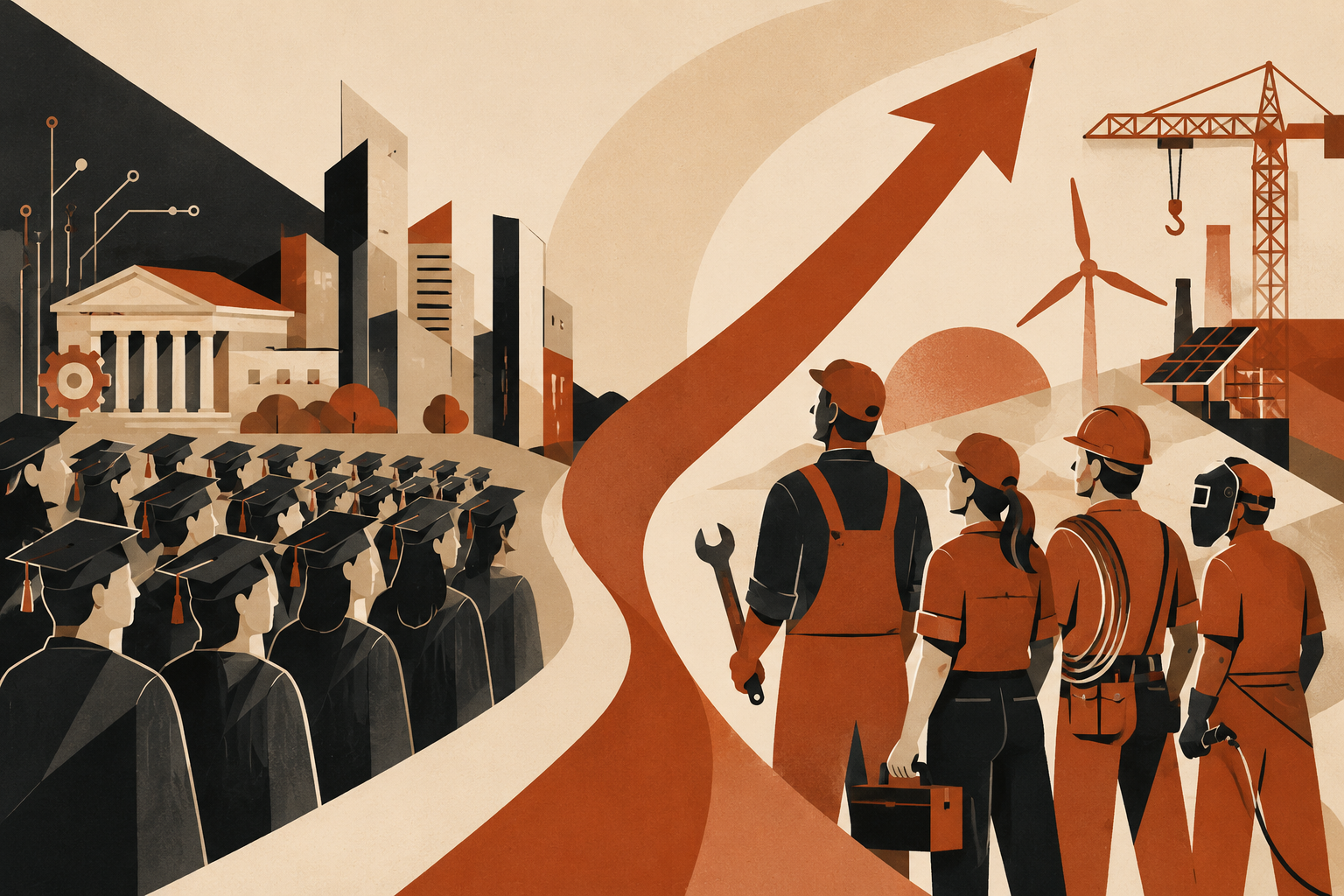
Every year, India produces roughly fifteen lakh engineering graduates. That is more than the United States and China combined. Walk into any middle-class home in Pune, Hyderabad, or Indore, and the script is identical: science in eleventh, coaching classes by sixteenth, engineering by eighteen. The degree is not a career choice. It is a social insurance policy.
The problem is that the policy is lapsing.
When the Credentials Loose Value
The global data tells a story that Indian placement cells are quietly living. In the United States, the Bureau of Labor Statistics projects 9% job growth for electricians through 2034. Mechanical engineers? 9.1%. The growth curves have converged. But the supply curves have not. McKinsey's 2024 labor report found twenty job openings for every single new hire across twelve critical skilled trades in the US. In the UK, nearly half of all skilled trades vacancies are now "skill-shortage vacancies" — the highest rate of any occupation group.
India is running the opposite experiment. We are still optimising for degree production in a market that is rewarding capability. The World Economic Forum's 2025 Future of Jobs Report found that 63% of employers globally now cite skills gaps — not capital, not regulation — as the primary barrier to transformation. The gap is not a lack of degrees. It is a lack of people who can do things that are hard to automate, hard to certify, and hard to outsource.
The Automation Paradox, Indian Edition
There is a persistent belief in Indian households that physical work is low-status because it is low-skill and easily replaceable. The evidence points the other way. The WEF report notes that 82% of the reduction in human-performed tasks is being driven by automation, but the tasks that remain stubbornly human are the ones requiring physical presence, contextual judgment, and fine motor control in unpredictable environments.
You can train a model to write boilerplate code. You cannot yet train a robot to navigate a flooded Mumbai basement, diagnose a faulty HVAC system in a Chennai data centre, or repair industrial conduit in a century-old textile mill. Engineers design the systems. Technicians keep them running. Both matter. But the labour market is signaling clearly: we are not producing enough people who can do the latter.
This is already visible in India's own economy. The premium on a generic engineering degree has compressed while specialised technical roles — industrial maintenance, CNC operation, robotics technician positions — carry increasing wage premiums. The market is not rejecting technical knowledge. It is rejecting the assumption that a four-year degree is the only valid container for it.
The Mathematics of Status
The median US electrician earns $62,350 — roughly ₹52 lakh annually. The median mechanical engineer earns $102,320, or about ₹85 lakh. The gap looks decisive until you account for the four years of lost earnings and the student debt load that engineering graduates carry. A trade apprentice starts earning at nineteen. An engineering graduate starts at twenty-three, often with a loan EMI.
In India, the math is even more stark. A typical private engineering college costs ₹4–8 lakh in tuition. An ITI course costs a fraction of that. The engineering graduate enters a campus placement market where median offers at tier-2 and tier-3 colleges have stagnated between ₹3–4 lakh per annum. A skilled electrician, plumber, or industrial maintenance technician in a major Indian city can earn comparable or better money — often in cash, often with overtime, and with no education loan to service.
The status hierarchy says otherwise. But the status hierarchy is lagging the market by about a decade.
What Germany Knows That India Doesn't
Germany's apprenticeship system is not a fallback for weak students. It is a parallel track that produces Meister-level technicians who earn salaries that rival engineering managers. The social prestige attached to the credential is different, but the economic outcome is not. India has ITIs, but they are treated as terminal destinations for students who "could not make it" — not as intentional pathways to scarce, high-value skills.
This is the core shift: the future does not belong to tradespeople, instead, of engineers. It belongs to people whose skills are genuinely scarce and genuinely hard to replicate. Right now, that describes a widening swath of skilled technical roles. The credential is losing ground to the capability. The market is just doing the math faster than Indian families are.
The Bottom Line
The engineering degree is not dead. It is simply no longer the only rational path to economic security. For a country that produces fifteen lakh engineers annually — many of them in disciplines with no organic demand — the scarcest resource is no longer the credential. It is the willingness to acquire a skill that the market actually needs.
The future belongs to the scarce. And in India, scarcity is increasingly a function of what you can do, not what degree hangs on your wall.
---
*Sources: U.S. Bureau of Labor Statistics (2024-2034 projections, May 2024 OES); McKinsey & Company, "Tradespeople Wanted" (2024); UK Employer Skills Survey 2024; World Economic Forum, Future of Jobs Report 2025; All India Council for Technical Education (AICTE) enrolment data.*